
Google search is no longer just about blue links and traditional rankings. With the rise of AI Overviews (formerly SGE – Search Generative Experience), search results are now powered by advanced AI models that summarize, interpret, and recommend content directly to users. This shift has fundamentally changed how visibility works and what qualifies as content that ranks on Google today.
In the AI-driven era, ranking is no longer only about keywords or backlinks. Instead, Google focuses on understanding intent, context, and trust while selecting content for both organic listings and AI-generated answers. To stay competitive, brands must rethink their AI SEO content strategy and create content that serves both humans and AI systems.
We will explain how to create content that ranks on Google in the age of AI search, how Google’s AI works, and how to optimize content for long-term visibility.
What Is AI Search and Google AI Overview?
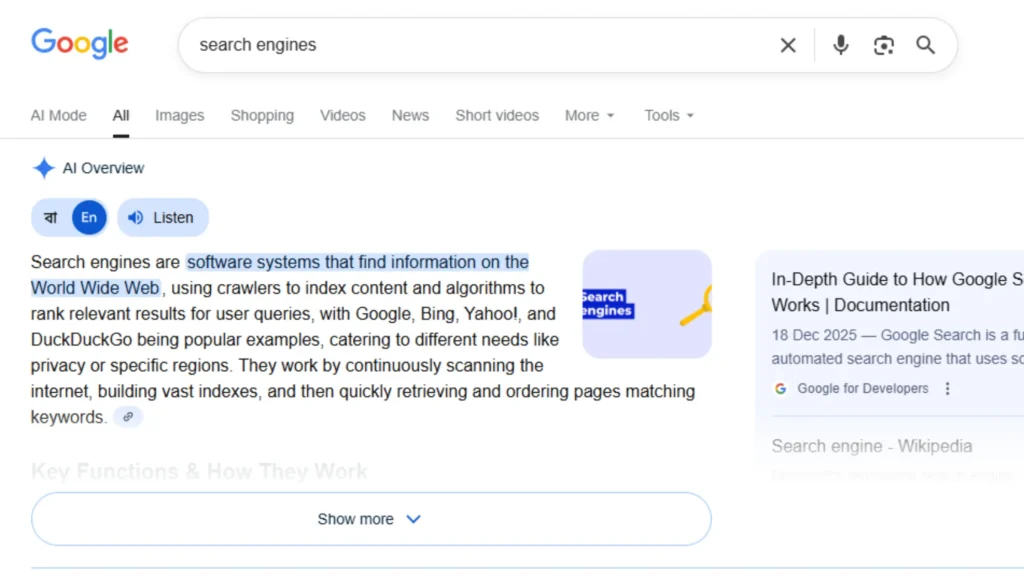
Google’s AI Overview is an AI-generated snapshot that appears at the top of search results for many informational queries. AI search uses artificial intelligence to understand user intent, context, and meaning behind queries to deliver direct, accurate answers instead of just listing links. It powers features like Google AI Overviews by summarizing and ranking the most helpful content from across the web.
This means:
- Users may get answers without clicking a website
- Visibility is no longer limited to position #1
- Being cited or referenced by AI becomes as important as ranking
Content ranking in AI search depends on how well your content answers questions clearly, accurately, and comprehensively. Google’s AI systems analyze multiple sources and choose content that demonstrates expertise, clarity, and relevance.
How Google’s AI Is Changing Ranking Signals
Traditional SEO focused on keywords, backlinks, and technical optimization. While these still matter, how to rank in Google AI mode now depends on deeper signals:
- Semantic relevance instead of exact-match keywords
- Clear structure and scannability for AI extraction
- Topical authority across a subject, not a single page
- Demonstrated expertise and trust (E-E-A-T)
- Fresh, up-to-date information
Google’s AI prefers content that is easy to interpret, factually sound, and genuinely helpful. Thin, generic, or heavily AI-generated content without originality struggles to gain visibility.
Core Principles of Content That Ranks in the AI Era
Create Human-First, Helpful Content
Google has repeatedly emphasized “helpful content.” AI systems are trained to prioritize content that genuinely solves problems, not pages written solely to rank.
To create content that ranks on Google, focus on:
- Answering real user questions
- Providing depth, examples, and actionable insights
- Avoiding fluff or surface-level explanations
Content that adds new value has a much higher chance of being used in AI Overviews.
Read Also: Local SEO Guide: How to Rank Your Business on Google Maps
Structure Content for AI and Users
AI systems rely heavily on structure. Clear headings, concise paragraphs, and logical flow help Google understand your content faster.
Best practices include:
- Descriptive H2 and H3 headings
- Short, focused paragraphs
- Bullet points and numbered lists
- Clear summaries within sections
This structure improves content optimization for AI search while also enhancing user experience.
Demonstrate Expertise, Authority, and Trust
E-E-A-T (Experience, Expertise, Authority, Trust) is critical in AI-powered rankings. Google wants to surface content written by knowledgeable sources, especially for complex or high-impact topics.
Ways to improve trust:
- Use accurate, current information
- Avoid exaggerated claims
- Support points with real-world examples
- Maintain consistency across related content
Strong authority increases the chances of your content being referenced in AI Overview Google results.
Keep Content Fresh and Updated
AI Overviews favor recent and accurate content. Outdated statistics, broken links, or obsolete advice reduce your chances of ranking.
Regular updates signal to Google that your content remains relevant. Refreshing existing pages is just as important as publishing new ones.
Step-by-Step Framework to Create AI-Optimized Content
Start With Intent-Driven Research
Keyword research still matters, but intent matters more. Look beyond search volume and understand why users are searching.
Focus on:
- Question-based queries
- Informational and problem-solving searches
- Topics that trigger AI Overviews
This approach supports a smarter AI SEO content strategy.
Build Topic Clusters Instead of Single Pages
Google’s AI evaluates authority at the topic level. Instead of isolated articles, create clusters of related content that interlink naturally.
For example:
- Pillar page explaining a core topic
- Supporting articles answering related questions
- Internal links that reinforce topical relevance
This improves content ranking in AI search by signaling depth and authority.
Write With AI Extraction in Mind
To optimize content for AI search, make key information easy to extract:
- Include concise definitions
- Answer questions directly
- Use FAQ-style formatting where relevant
- Add brief summaries for long sections
AI systems often pull clearly written explanations into overviews.
Use Schema and Structured Data
Schema markup helps Google understand your content contextually. FAQ, HowTo, and Article schema improve eligibility for enhanced visibility in AI-powered results.
While schema doesn’t guarantee rankings, it significantly improves interpretation.
Enhance Content With Visuals
Charts, diagrams, and visuals add clarity and engagement. They also support comprehension, which indirectly helps AI systems identify key concepts.
Technical SEO Still Matters
Even in AI search, technical foundations remain critical:
- Fast-loading pages
- Mobile-first design
- Clean HTML structure
- Proper internal linking
Without strong technical SEO, even great content may struggle to surface in AI-driven results.
The Future of Content Ranking on Google
AI-powered search will continue to evolve. However, the core principle remains the same: Google wants to surface the most helpful, accurate, and trustworthy content. If you focus on value instead of shortcuts, your content that ranks on Google will remain resilient—even as algorithms change.
Want to future-proof your visibility with AI-ready content and measurable growth? Partner with a trusted Performance Marketing Agency that combines SEO, AI strategy, and conversion-focused content to help your brand dominate modern search.
FAQs
1. Can AI-generated content rank on Google?
Yes, AI-generated content can rank if it is accurate, helpful, original, and reviewed by humans to ensure quality and trustworthiness.
2. How to write content that ranks on Google today?
Create human-first, well-structured content that answers search intent clearly, demonstrates expertise, and stays updated.
3. What is Google AI Overview?
Google AI Overview is an AI-generated summary shown in search results that combines information from multiple trusted sources.
4. Does AI search replace traditional SEO?
No. Traditional SEO still matters, but it must be combined with AI-focused optimization and content depth.
5. How to rank in Google AI mode?
Focus on clear answers, structured content, topical authority, and trust signals across your website.
6. What type of content performs best in AI search?
What type of content performs best in AI search?
7. Is content optimization for AI search different from normal SEO?
Yes. It emphasizes semantics, clarity, authority, and structure rather than just keywords.