
If you’ve checked Search Console lately and felt your stomach drop a little — you’re not imagining it. Rankings look fine. Content hasn’t changed. Traffic has. And somewhere in the back of your mind, a little voice is saying: it’s the AI thing, isn’t it?
It is, partly. Google AI Overviews — the AI-generated summaries that now sit above the regular blue links — have quietly changed how people search. But “killing traffic” is a headline, not a diagnosis. The real story is messier, more uneven, and honestly more useful once you see the actual numbers instead of the panic.
So let’s look at what’s genuinely happening in 2026, using data you can trace back to a source — not vibes.
What’s Actually Happening Right Now with Google AI Overviews & Organic Traffic
Here’s the cleanest number I found, and it kind of says everything: Pew Research Center studied 68,000 real search queries and found people clicked through 8% of the time when an AI Overview appeared, compared to 15% when it didn’t. Almost half the clicks, gone, just because a summary showed up first.
That’s the heart of the AI Overviews impact on traffic conversation. When Google answers the question for someone right there on the results page, a chunk of people simply… don’t click anywhere. Not because your content is worse. Because there’s nothing left for them to go looking for.
The Real Numbers Behind AI Overviews CTR and Traffic Decline
This is where most blogs either exaggerate or cherry-pick. Here’s what’s actually documented, source by source:
- Seer Interactive analyzed over 3,100 queries across 42 organizations and found organic AI Overviews CTR fell from 1.76% to 0.61% for queries where an Overview appeared — a 61% drop.
- Ahrefs tracked clicks to the #1 organic result specifically: down 34.5% in April 2025, and down 58% by December 2025. It’s not slowing down — it’s accelerating.
SparkToro’s 2026 Datos panel study found fewer than one in three Google searches in the US now send a click to the open web at all. - Chartbeat data, published in the Reuters Institute’s 2026 Journalism and Technology Trends report, showed global publisher Google search traffic dropping by roughly a third, with Discover referrals down 21% year-over-year.
- Named publishers have gone public with their numbers too: Business Insider lost 55% of organic traffic between April 2022 and April 2025 (and cut staff by 21%), CNN saw declines of 27–38%, and Chegg’s revenue fell 24% year-over-year — steep enough that Chegg sued Google over it in early 2025.
But if you want the single most credible proof that Google AI Overviews organic traffic loss is real, don’t look at a blog. Look at Alphabet’s own Q1 2026 earnings, filed April 29, 2026. Google’s third-party publisher ad revenue (AdSense, AdMob, Ad Manager) fell 4% year-over-year to $6.97 billion. Meanwhile, Google’s own search revenue grew 19% to $60.4 billion. That gap, in a public financial filing, is about as close to a smoking gun as this conversation gets.
Ready to protect your traffic before the next algorithm shift catches you off guard? Start by auditing which of your top informational pages are losing clicks to Google AI Overviews — and rebuild your content strategy around citations, not just rankings.
Contact us today to get a free audit of your affected pages.
Google’s Counter-Argument: The Bounce Click Explanation
Here’s where it gets more interesting than “AI bad, publishers sad.” In April 2026, Google’s Head of Search, Liz Reid, went on Bloomberg’s Odd Lots podcast and offered a google Ai bounce click explanation: she argued AI Overviews are mostly cutting “bounce clicks” — the kind where someone clicks through, skims for one fact, and immediately hits back. Her point was that these were never valuable visits to begin with, and that users who genuinely want to read further still click through.
It’s a reasonable argument. It’s also one Google hasn’t backed up with actual data anyone outside the company can check. So take it as a real, worth-knowing explanation — not the full picture. The publisher-side numbers above suggest the losses go well beyond low-value bounce traffic.
It’s Not All Loss — What’s Actually Growing
Here’s the part that gets buried under the doom headlines: AI-driven search traffic itself is growing fast. Wix’s AI Search Lab reported AI search visits jumped 42.8% year-over-year in Q1 2026, from 15.6 billion to 27.4 billion. And the visitors who do click through from AI citations tend to be more qualified — they’ve already had their basic question answered, so the click they make is a more intentional one. Semrush projects AI search visitors will actually overtake traditional search visitors by 2028.
So the honest framing isn’t “traffic is dying.” It’s that raw click volume is shrinking for informational content, while the clicks that remain are becoming more valuable — and a new channel (AI citations) is opening up alongside the old one.
Who’s Actually Getting Hit Hardest
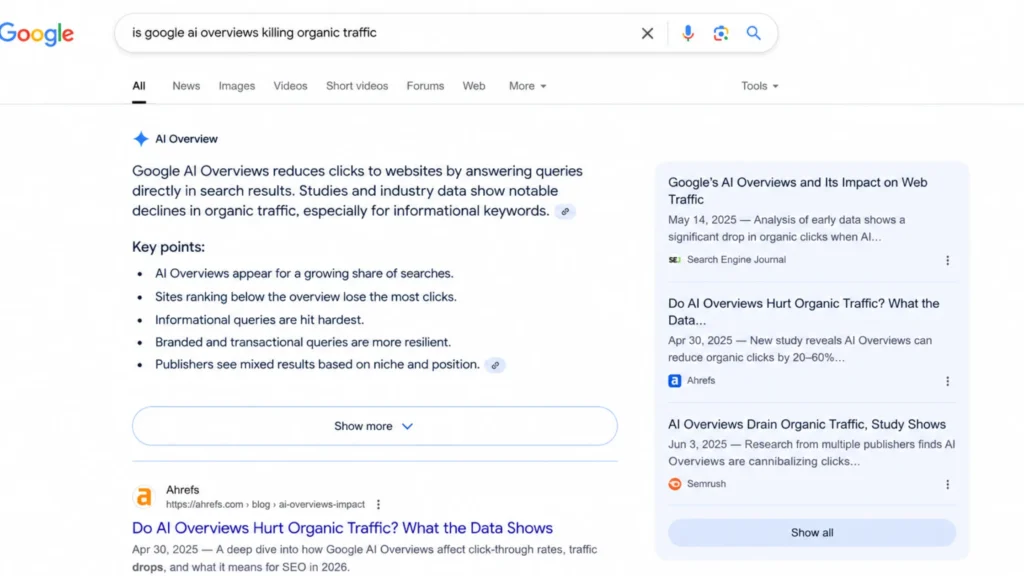
Not every type of content is affected equally. AI Overviews trigger almost exclusively on informational, question-style searches — think “how does X work” or “what is Y.” Transactional and local searches barely trigger them at all. So if your traffic comes mostly from guides, explainers, and “what is” content, you’re in the blast radius. If it comes from product pages, local intent, or bottom-funnel searches, you’re largely untouched for now.
What To Actually Do About It
None of this means give up on organic content — it means changing what you’re optimizing for.
- Answer the core question directly in your first two or three sentences. Retrieval systems reward clarity over cleverness.
- Build depth across a topic cluster instead of one giant page trying to cover everything.
- Include original data, first-hand experience, or expert quotes — AI can only summarize what already exists; it can’t invent your unique insight.
- Update your content regularly. Pages left untouched for a quarter or more are far more likely to lose AI citations over time.
- Keep your technical SEO and schema clean. It won’t guarantee an AI citation, but it keeps you eligible for one.
Final Thought
The AI Overviews traffic decline is real — the data backs that up clearly, from Pew’s click-through numbers to Alphabet’s own earnings report. But “killing” is the wrong word. What’s actually happening is a redistribution: fewer casual clicks, more qualified ones, and a growing citation-based channel sitting alongside the traditional one. The sites that treat this as the end of organic search will keep losing ground. The ones that adapt what “success” means — clicks and citations — are the ones still standing in 2028.
If you’re seeing a drop in your own traffic right now, don’t panic-rewrite everything. Start by checking which of your pages are informational, which queries used to send you clicks, and whether an AI Overview now sits above you for those exact terms. That’s where the real answer is — not in another statistics roundup, but in your own Search Console data.
Frequently Asked Questions
Does Google AI Overview reduce website traffic?
Yes, for many informational queries. Pew Research found click-through rates drop from 15% to 8% when an AI Overview appears, and multiple independent studies from Seer Interactive and Ahrefs show similar declines specifically tied to AI Overview placements.
Why is my organic traffic dropping even though my rankings haven’t changed?
This is one of the most common patterns in 2026. Your ranking position can stay exactly the same while your clicks fall, because an AI Overview above the results is now answering the query before users ever reach your listing. Check Search Console’s “AI Overviews” filter (where available) or compare click data for queries where you know an Overview appears.
What does Google mean by “bounce clicks”?
It’s the term Google’s Head of Search, Liz Reid, used in April 2026 to describe quick click-and-return visits — where someone clicks a result, grabs one fact, and immediately returns to search. Google’s argument is that AI Overviews mainly reduce this low-engagement type of click, though it hasn’t released data to independently verify the claim.
How do I get my content cited in AI Overviews?
Answer the query directly and early in your content, build topical depth rather than one-off pages, include original data or first-hand expertise, and keep your pages updated regularly — content untouched for a quarter or more is significantly less likely to be cited.
Is SEO still worth it with AI Overviews taking over search results?
Yes, but the goal is shifting. Traditional SEO focused on ranking for clicks. In 2026, the same fundamentals — relevance, authority, freshness, clear structure — also determine whether AI systems cite you at all, which is becoming its own valuable form of visibility even without a click.